A great paradox of executive function is that many struggling people are unknowingly creating queues of future work they will never do.
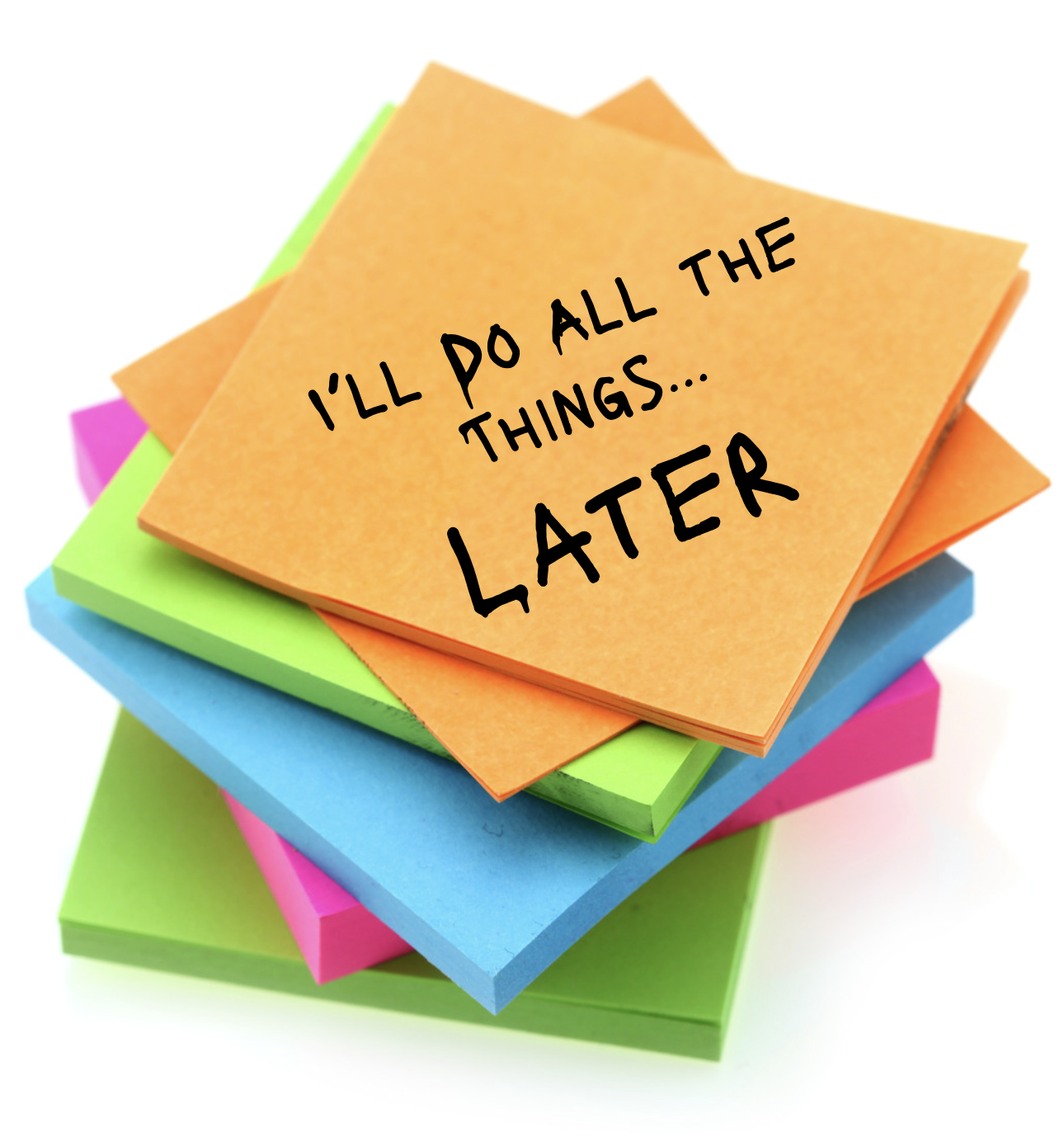
Consider the humble sticky note. The work on it has been mentally tagged for future attention. Each decision to act in the future feels responsible and checks the mental box of “working on it.” But instead of taking action now, each item written on it is instead a spaceholder. This can unintentionally create friction and add to the bottleneck that discourages future action.
The Later Promise
One kind of friction is in the “later” promise. Everyone does this. A person might say to themselves, “I’ll deal with that tomorrow,” and feel, in the moment, like they’ve already handled it. For students it can sound even more specific: “I’ll make a flashcard later.” “I’ll organize those notes later.” “I’ll make a study guide later.” “I’ll look up that concept later.” “I’ll ask the teacher about that later.” “I’ll create a practice test later.” In both cases the person has now accumulated a set of partially formed intentions, but no substantive work has been completed. When too much of this happens and pressure builds, it is often followed by anxious avoidance.
One of the most useful questions we can ask about any kind of work is: “What is the next useful action I will do right now?” Students are the clearest place to see this, because the materials for their next action are usually readily available to them in some form. They likely have the list of terms to know, and slides with diagrams anchoring salient concepts. When a student assures you they are “going over” their work to see what they don’t understand, they likely feel that they are studying. However, they could be using that same time to make reusable learning cues like flashcards or practice tests, rather than imagining the work might make more sense when they come back to it later.
Closing the Gap
Clients tell me they want to work “smarter.” What they actually want is to feel less pressured. In areas where they are already efficient, often without quite naming it, they already do something specific: They make small pauses to ask themselves what they will need to be successful, even in small ways.
In the student example, the person has learned that previewing course materials before they’re due to use them means having a view of the terrain before the “game of learning” begins. When they have a question, they don’t assume they’ll remember it. They write it down. They save a pdf of reading materials and write questions in the document they’re already working in. When they realize a concept is important, they don’t just color code it for later. They annotate with margin notes, not just highlighting, and create a retrieval cue immediately. They write the flashcard or study question, right then. They don’t wait to see if this turns out to be necessary. That habit alone keeps the gap between “noticing” and “doing” smaller. It also increases retention and provides ready-to-use study materials for assessments.
Students with executive function challenges often have the opposite pattern. The noticing –> doing gap becomes larger. As the “later” queue grows, so does the cognitive load required just to manage how big that feels. Every placeholder becomes a kind of debt to the future. The student perpetually relies on a system that needs future memory, future motivation, future time, and future organization all to show up at once, later, instead of creating small, new, reusable learning now.
They’re also building unnecessary gates between recognizing what needs to happen and actually making it happen. Every gate like this is another chance for friction, forgetting, avoidance, or overload. Eventually the student is no longer studying biology, or economics, or chemistry. They are managing a growing inventory of overwhelming incomplete intentions, and missing the chance to build a reusable study tool the first time content is introduced. Think geometry theorems and postulates, or the periodic table of elements. Students will not get far without them, but might treat those foundational tools as “so last unit.”
Starting Sooner Saves Steps
None of this is about trying harder. It’s about how many steps “the work” actually takes. Capturing a gap the moment you notice it is key to a shorter and more focused workflow:
Notice → Capture → Continue studying/working → Outcome: Work, learning, and study materials created simultaneously
Deferring the same gap till later is a much longer workflow, even though it doesn’t feel longer in the moment:
Notice → Decide it can wait → Keep going → Later, half-remember → Assume you’ll recognize it when you see it again → Go looking for it → Maybe find it, maybe not → Capture it in a rush, if at all → Discover, under pressure, that you still don’t know it → Outcome: Wonder why all that work didn’t pay off
For a student with executive function challenges, every one of those extra steps is a place where memory, time, or follow-through can fail, not because of a lack of effort, but because each step requires its own small act of executive control to complete. The shorter workflow doesn’t just save time. It removes most of the places where the system can break down. That is the real reason it works better, not because the person who uses it is trying harder, but because there are fewer failure points and so much less that has to go right.
Smaller, Sooner, Stronger
Documenting new learning and creating retrieval cues immediately is almost always easier and more effective than creating a reminder to do it later. It also lets learning build and compound, instead of waiting for the study guide to tell you what will be on the test. It interrupts the adrenaline cycle that keeps a person waiting for enough fear to surface before they’ll act. Managing the queue this way keeps the workload in smaller, manageable pieces, and it heads off the procrastination that overload tends to produce.
I hope you’ve noticed that this is not just about students, or studying. It’s about what you do with the small thing you just noticed. The email you’ll answer later. The receipt you’ll file later. The conversation you’ll have later, once you’ve figured out what to say. Later. Each one is still a placeholder, quietly added to a queue that has to be carried, item by item, until something finally lightens the load.
_______________
I’m an applied researcher and coach studying the terrain where work and effort collide.